


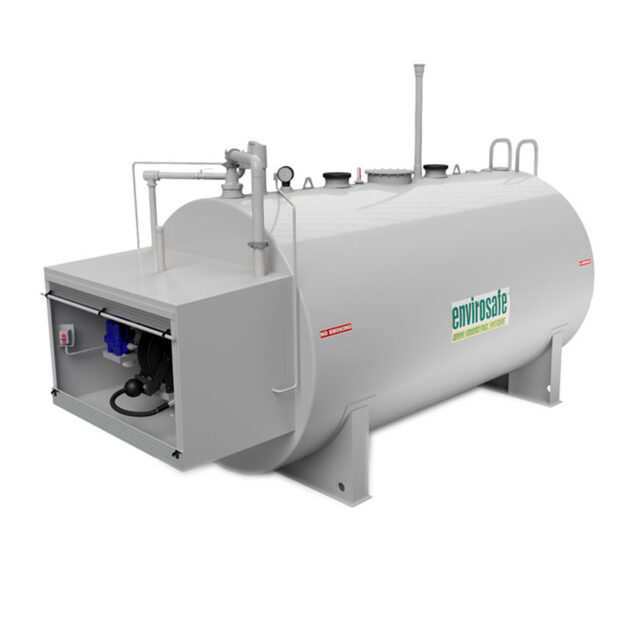
Gallery includes representative tank and equipment arrangements. Confirm the exact size and supplied configuration on your project drawing. Select a thumbnail to inspect the gallery.
F-FLEET / FARM & GROUND FLEET FUELING
Simplicity. Lower upfront cost.
5,000 gallons nominal, with 4,500 gallons at the 90% operating target. A strong starting point for farms, owner-operators and fleets that prefer straightforward equipment.
- Operating fuel
- 4,500 gal at 90% operating / alarm
4,750 gal at 95% maximum / shutoff - Equipment
- Metered open-hose dispensing
- Before choosing
- Confirm top-fill compatibility with your delivery provider and allow for seasonal or peak fuel use.
Your quote confirms the tank construction, equipment and project scope.
01 / SYSTEM SCOPE
Know what you’re buying.
Store and dispense fuel on site with a straightforward tank, pump, meter and open-hose arrangement. Envirosafe builds the complete package around your operation.
Store for the season
Size storage around daily and peak demand, supplier lead time and fuel turnover.
Dispense simply
Specify the submersible pump, metering, filtration, hose and nozzle for the fuel and equipment.
Match the delivery
Confirm top-fill access and delivery-provider compatibility before selecting the arrangement.
The hose and equipment remain exposed. This arrangement has no lockable dispensing cabinet or self-retracting reel.
02 / CAPACITY, DELIVERY & FUEL TURNOVER
Will your reorder reserve
last until delivery?
Choose capacity around your delivery quantity and the fuel you need while waiting for the truck. Then check that your consumption supports regular fuel turnover.
For aboveground atmospheric tanks, plan around 90% of nominal volume, with 95% as the maximum fill. The overfill alarm sounds at 90%; the overfill-prevention device stops additional fuel entering at 95%. Keep normal operation at the 90% target. Confirm the supplied devices, settings and minimum fuel needed for pump drawdown.
Check your delivery plan.
Start with daily use. Add delivery lead time when you know it.
Allow for fuel that must stay in the tank
Include fuel below the pump’s usable drawdown level and any minimum inventory you want to retain. Blank assumes zero; confirm this amount before relying on the time allowance.
Use expected consumption during the delivery wait; allow for busy periods. Blank delay buffer and minimum fuel are treated as zero. These inputs do not submit a quote.
THE BUYING ADVANTAGE
Plan for truckload pricing.
We use 7,500-gallon deliveries as the benchmark for the best wholesale rate per gallon. Confirm the supplier’s actual load size, delivered price and lead time for your location.
THE FUEL-QUALITY CHECK
Use fuel while it is fresh.
Divide the 4,500-gallon operating target by daily use to estimate the days of fuel on hand.
Review that turnover with your fuel supplier for your fuel, blend and storage conditions. Bigger storage only helps when the delivery reserve and fuel turnover both fit your operation.
5,000gallons nominal
4,500 gal at 90% operating / alarm
4,750 gal at 95% maximum / shutoff
6,000gallons nominal
5,400 gal at 90% operating / alarm
5,700 gal at 95% maximum / shutoff
03 / DRAWINGS & SPECIFICATIONS
Dimensions, weight
and equipment.
Review the published reference for this capacity. Tank dimensions and the complete installed footprint are different measurements.
Fireguard® (UL 2085) F-Fleet drawing
- Tank body length
- 187 in ± 3 in
- Overall length shown
- 209 in ± 3 in
- Tank outside diameter
- 100 1/2 in
- Saddle/base width
- 90 1/4 in
- System weight shown
- 18,250 lb
Measurements and weight describe the configuration shown in the linked drawing. Tank body length excludes mounted equipment. Confirm shipping dimensions, installed clearances and the selected equipment on your approved project drawing.
04 / DELIVERY & STARTUP
Prepare the site.
Plan the first fill.
Agree who supplies the equipment and who completes each site task. Include inspection and fuel-delivery appointments in the operating schedule.
- 1
Approve the location
Resolve tank construction, capacity, placement and applicable permits before fabrication and site work.
- 2
Prepare the site
Complete the designed foundation and utility routes. Arrange the carrier, unloading equipment and installer.
- 3
Connect and inspect
Complete the specified anchoring, piping, electrical work and required tests. Book inspections before the first fuel fill where required.
- 4
Start and hand over
Coordinate fuel delivery with the approved startup procedure, verify the fitted controls and train the operators.
05 / PLAN THE INSTALLATION
Plan your 5,000-gallon
F-Fleet installation.
Understand the power, space and preparation your project needs before equipment arrives.
ELECTRICAL PREPARATION
Single-phase pump supply.
Electrical callouts for the configuration in the linked drawing. Equipment options can change the final requirements.
- Pump field connection shown
- 220 V · single phase
- Amperage / branch circuits
- Not specified in these reference drawings; size from the final equipment schedule
The drawings use the voltage labels shown above. Confirm the supply against the selected pump and dispenser ratings before circuit design. Include monitoring, fuel-management and other accessory loads.
Fireguard electrical reference, PDF p. 3 ↗
What your electrician needsHow much of the 5,000 gallons can I use?
5,000 gallons is the nominal volume. Plan around 4,500 gallons at 90% operating capacity, with 4,750 gallons at 95% maximum fill. Fuel below the pump’s usable drawdown level and any retained reserve reduce the amount available to dispense. On equipped fuel systems, the overfill alarm is set at 90% and overfill prevention at 95%; verify the supplied devices and settings. Bare tanks require these devices separately.
How do I choose Fireguard or Flameshield?
Fireguard® is a UL 2085 protected tank with thermal insulation. Flameshield® uses UL 142 steel-tank construction and a separate two-hour fire test under SwRI 97-04. The fire-test descriptions are different classifications; a Flameshield tank does not meet a requirement for a UL 2085 protected tank.
For motor-fuel dispensing, NFPA 30A and the adopted state or local fire code can affect tank construction, permitted capacity and separation distances. Fuel classification, attended or unattended use, nearby buildings, property lines and public roads all belong in that review. Commercial use alone does not establish one nationwide tank requirement.
If your proposed location needs a protected tank, specify UL 2085. Where the adopted rules allow the selected UL 142 arrangement, compare its required space and equipment with Fireguard before choosing.
See how tank protection changes site planningHow much room does the installed system need?
- Fireguard: 209 in ± 3 in overall length in the reference drawing.
Add room for top-fill access and safe hose storage, fuel deliveries, vehicle turning and any required separation from buildings, roads and property lines. The foundation must be designed for the installed loads and anchorage, including stored fuel.
Where vehicle impact protection is required, its location and spacing add to the reserved area. Count posts for each exposed side and access opening on the site plan; tank gallons alone cannot determine the number.
View the bollard spacing exampleWhat concrete slab and how many bollards does a 5,000-gallon tank need?
Envirosafe’s suggested slab for a 5,000-gallon tank, from its concrete specification sheets:
| Tank construction | Suggested slab | Thickness | Suggested bollards |
|---|---|---|---|
| Fireguard® (UL 2085) | 15′-11″ × 26′-6″ | 8-inch slab on grade | 18 |
| Flameshield® (UL 142) | 15′-7″ × 25′-7″ | 8-inch slab on grade | 18 |
Slab on grade using 3,000 psi concrete with wire mesh and #5 rebar at 12 inches on center. These are Envirosafe’s suggested starting sizes for the tank and its mounted equipment. The project engineer designs the foundation for the site’s soil, frost depth and installed loads, and the fire official confirms the bollard layout for each exposed side.
See the suggested slab and bollards for every capacityWho decides what I can install at this address?
An authority having jurisdiction (AHJ) is the office responsible for a particular approval. Start with the fire-prevention office serving the installation address and the local planning/building department.
The fire official reviews fuel storage and dispensing arrangements. Planning reviews the proposed land use; building and electrical officials review the work within their jurisdiction. The state or local environmental program may also require tank registration, spill-prevention measures or approvals.
Bring the address, site plan, fuel types, tank capacities, construction listing and equipment drawing. Ask which code edition and local amendments apply, which permits are needed, and which inspections must happen before the first delivery of fuel.
See who reviews each part of the projectHow soon can I fuel after delivery?
This turnkey system can be up and running within the day it arrives at a prepared, approved site. Factory assembly leaves the placement, specified utility connections and startup tasks to complete onsite.
For delivery-day fueling, have the site work, required approvals, unloading team and utilities ready in advance. Coordinate final connections, any required inspections, the first fuel delivery and startup checks for that day.
Compare startup work, installed cost and future reuseWhat can I reuse if my location changes?
The tank and integrated dispensing equipment are designed to remain a reusable package. Keeping the factory plumbing and equipment together preserves much of the original assembly work when the system moves.
Plan qualified draining and preparation for transport, utility disconnection, lifting and haulage, followed by installation and commissioning at the destination. Check equipment condition, fuel compatibility and the new site’s approval requirements. Foundations, bollards and site utilities are separate from the movable equipment.
Evaluate what you can keep, replace or upgradeChoose by how your fleet fuels
How F-Fleet compares.
Compare protected equipment, driver experience and serviceability. Keep the strengths and tradeoffs in view.
| What matters to your fleetThe same criteria, side by side. | C-FleetDurability & protection | D-FleetFamiliar fueling | You’re viewingF-FleetLower upfront cost |
|---|---|---|---|
| Reliability | |||
| Low maintenance | |||
| Ease of use | |||
| Weather resistance | |||
| DIY serviceability | |||
| Strong fit when… | Demanding fleet use, harsh weather and protected dispensing equipment.Heavy fleet use & harsh weather | A wide mix of drivers who benefit from familiar fuel-station operation.Mixed drivers & familiar operation | Farms, smaller fleets and owner-operators prioritizing simplicity and cost.Farms, small fleets & tighter budgets |
| The tradeoff | Heavier doors and a spring-loaded reel take more effort to operate.Heavier doors & spring reel | Specialized dispenser service and hoses exposed to weather.Technician service; exposed hoses | Open hose, no lockable cabinet, and top-fill delivery compatibility to confirm.Open hose; top-fill delivery |
| Available tank sizesGallons nominal · Select a size for product details | |||
| Explore each system | Explore C-Fleet | Explore D-Fleet | Current system |


Compare metering, hose storage, fill points, maintenance, capacity and relative cost.
Envirosafe’s relative ratings: 5 is the strongest rating. Images show representative configurations.
YOUR NEXT STEP
Define your 5,000-gallon
f-fleet project.
Choose the equipment and delivery plan that fit your operation.